
The Tower in Tarot: When False Structures Fall
The Tower in tarot is not only a card of collapse or disruption. It reveals the truth beneath false structures, showing where denial, illusion, or unstable foundations can no longer stand.

A Guide to Disruption, Revelation, and the Truth Beneath Collapse
The Tower is one of the cards people often fear.
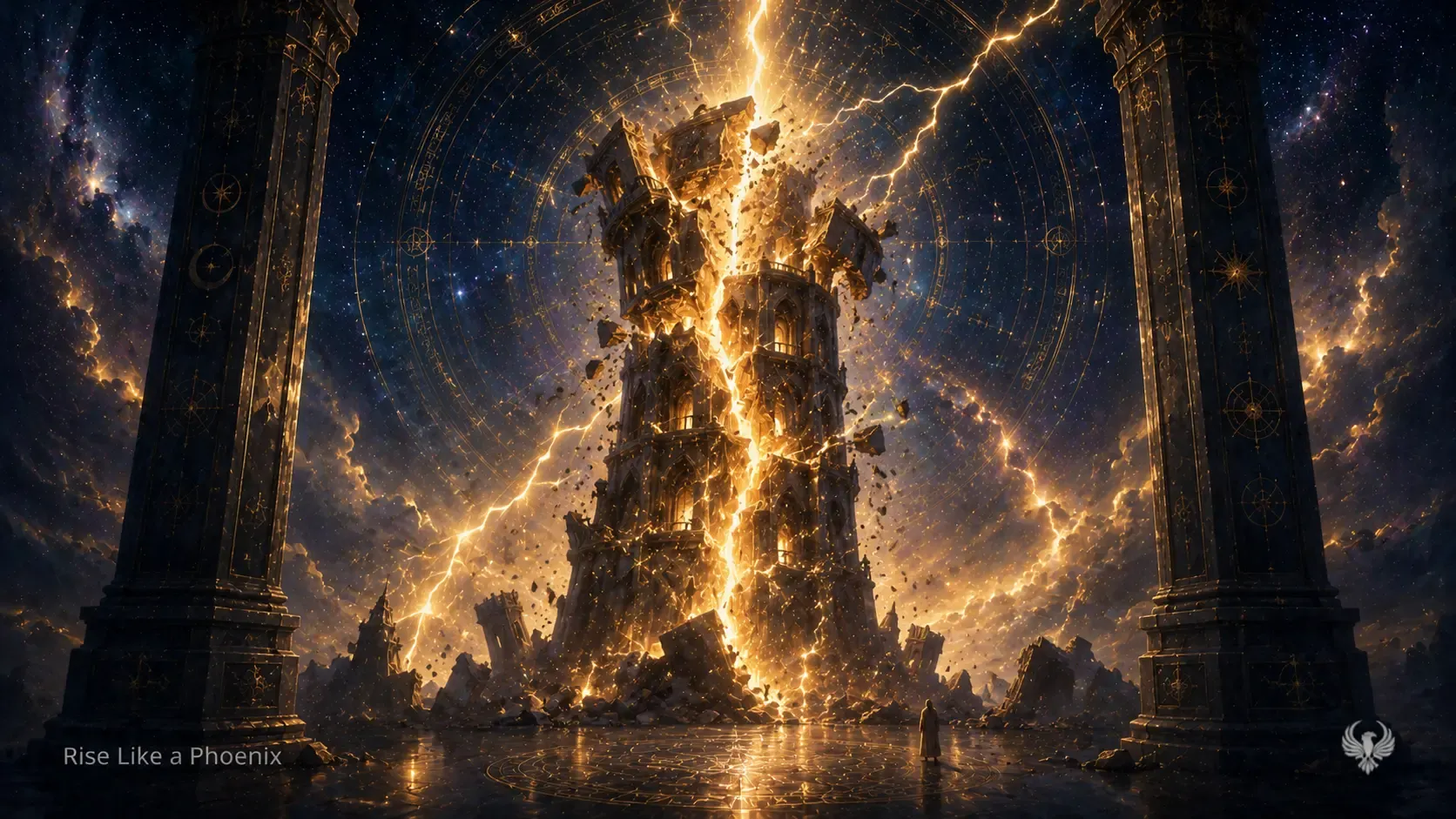
It can look sudden, severe, and disruptive. The image may suggest collapse, lightning, falling, fire, or something breaking apart before anyone feels ready.
Because of this, The Tower is often interpreted as disaster.
But The Tower is not only about destruction.
It is about revelation.
The Tower appears when a structure can no longer hold the truth it was built to avoid. Something false, unstable, rigid, or disconnected from reality breaks open, not because life is meaningless, but because the old structure can no longer stand.
This card can feel intense because it does not always ask politely.
It reveals what has already been cracking.
It exposes what denial has tried to protect.
It shows where truth has become stronger than the structure built to contain it.
The Tower in the Major Arcana Journey
In the wider journey of The Major Arcana as a Map of Spiritual Awakening, The Tower marks the stage where a false or unstable structure can no longer hold the truth beneath it.
Death asks what old form must be released.
The Devil asks what still has a hold on us.
The Tower shows what happens when the structure built around denial, bondage, false safety, or illusion can no longer remain standing.
This follows naturally from the pattern explored in The Devil in Tarot: The Patterns That Bind Us, where the card reveals the attachments, fears, and unconscious bonds that keep inner freedom limited.
Death can be gradual.
The Devil can be repetitive.
The Tower is often sudden.
It may feel like the moment when life interrupts the story we were trying to maintain.
But the interruption is not random. Often, The Tower reveals what was already unstable. The crack existed before the lightning. The lightning only made it visible.
Symbolism of The Tower
Different tarot decks portray The Tower in different ways, but the common symbolism often points toward collapse, shock, exposure, and sudden truth.
A tower may represent a structure of identity, belief, protection, pride, control, or false security.
Lightning may represent truth striking through illusion.
Fire may show purification, intensity, or the release of energy trapped inside an old form.
Falling figures may show the shock of losing a position, role, or self-image that once seemed secure.
A broken crown or shattered top may suggest the collapse of false authority, pride, or control.
In the Thoth deck, The Tower is especially forceful and fiery. The card carries a sense of explosive release, as though trapped energy is breaking through what obstructed living truth. It is not quiet. It is not gentle. But it is not meaningless.
The Tower's imagery asks:
- What structure is being shaken?
- What truth is breaking through?
- What was built too high, too rigid, or too far from the ground?
- What could no longer hold life honestly?
The Tower is frightening when we focus only on the collapse.
It becomes clearer when we ask what the collapse reveals.
The Tower Is Revelation, Not Punishment
The Tower is often experienced as shock, loss, exposure, or sudden change.
But spiritually, The Tower is not punishment.
It is revelation.
It may appear when a belief collapses, a relationship fantasy breaks, a hidden truth comes out, a system fails, a role no longer works, or an identity can no longer continue.
It can appear when something we trusted was not as stable as we thought.
It can appear when we realize that a life structure was built around fear, pride, avoidance, or control.
It can appear when a truth we tried to delay arrives all at once.
The Tower does not destroy truth. It destroys what could no longer protect us from truth.
This does not mean the experience is easy.
Truth can be painful when it breaks through a structure we depended on. A collapse can bring grief, fear, anger, confusion, or disorientation. The Tower should not be romanticized.
But it should not be reduced to catastrophe either.
The Tower asks us to see what has been revealed.
Not only what fell apart.
What The Tower Was Built to Protect
A Tower does not rise for no reason.
It is often built around something vulnerable.
Fear of uncertainty.
Fear of failure.
Fear of being wrong.
Fear of being abandoned.
Fear of losing identity.
Fear of grief.
Fear of being seen clearly.
Fear of ordinary human instability.
The Tower may be a relationship fantasy that protects us from the fear of being alone.
It may be a professional identity that protects us from the fear of not being valuable.
It may be a spiritual belief system that protects us from the discomfort of not knowing.
It may be a rigid routine that protects us from emotional chaos.
It may be a self-image that protects us from vulnerability.
This is why The Tower can feel so personal. It does not only break an outer structure. It reveals the fear, belief, or need that the structure was protecting.
The card asks:
- What did this structure make possible?
- What did it prevent me from seeing?
- What truth became too strong to stay hidden?
The answer may not come immediately. After a Tower moment, the nervous system may need time to settle before meaning can be understood. Because tarot can activate the body as well as the mind, it helps to pause, breathe, and notice whether the card is bringing clarity, fear, shock, or overwhelm.
The Tower may reveal truth suddenly.
But integration usually takes longer.
This is why it helps to approach intense cards through the body as well as the mind, as explored in Tarot, The Body, and The Nervous System: Why Tarot Can Trigger Emotions, Sensations, and Deep Inner Responses.
Collapse Is Not the Same as Failure
When something falls apart, the mind may call it failure.
The relationship failed.
The plan failed.
The belief failed.
The identity failed.
The life structure failed.
But The Tower asks us to look more carefully.
Not everything that falls was meant to stand forever.
Some structures fall because they were built on denial.
Some fall because they could not adapt.
Some fall because they were too rigid to hold real life.
Some fall because they were built around someone else's expectations.
Some fall because they protected a version of the self that was no longer true.
The collapse may still hurt. It may still have consequences. It may still require repair, grief, honesty, and care.
But collapse does not always mean the path is over.
Sometimes it means the false path has become impossible to continue.
The Tower does not promise immediate peace after disruption. It does not say, "This is fine". It does not ask to pretend that shock is comfortable.
It simply asks us not to confuse the fall of a false structure with the destruction of truth itself.
What is real may remain.
What is false may not.
The Shadow of The Tower
Every Major Arcana card has a shadow expression.
The Tower's shadow can move in two directions.
One shadow refuses truth until crisis becomes unavoidable.
It ignores cracks.
It avoids difficult conversations.
It delays action.
It protects the image.
It keeps building higher on an unstable foundation.
This shadow says:
- "It is not that bad."
- "I can hold this together."
- "If I do not look at it, maybe it will pass."
- "If I admit the truth, everything will fall apart."
But sometimes what falls apart is only the illusion that it was working.
The other shadow used rupture as a substitute for honest change.
It creates chaos before listening.
It mistakes drama for truth.
It uses "I am just being honest" as a weapon.
It destroys what still needs to be understood.
It becomes addicted to intensity because steadiness feels unfamiliar.
This shadow says:
- "Everything must burn."
- "If it is uncomfortable, I should destroy it."
- "Sudden change means awakening."
- "Disruption is always truth."
But not every rupture is wisdom.
Not every collapse is necessary.
Not every shock is spiritual clarity.
The shadow of The Tower either refuses truth until life breaks it open or uses rupture as a substitute for honest change.
A grounded relationship with The Tower can recognize when something false is falling without worshipping collapse itself.
When The Tower Appears in a Reading
When The Tower appears in a reading, pause before catastrophizing.
The card may point to disruption, exposure, sudden realization, collapse of illusion, or the breakdown of a structure that could no longer hold truth.
But it does not mean you should assume the worst possible outcome.
Ask what is being revealed.
In a relationship reading, The Tower may show the collapse of a fantasy, sudden truth, exposure of a pattern, or the end of pretending. It does not always mean the relationship ends, but it often means the old structure of understanding cannot remain unchanged.
In a career reading, The Tower may point to disruption in a role, workplace system, professional identity, or false sense of security. It may show that something you depended on is less stable than it appeared.
In a spiritual reading, The Tower may challenge a belief system, teacher attachment, spiritual identity, or certainty that has become too rigid. It may strip away the illusion that growth always feels peaceful.
In self-reflection, The Tower may ask where life has already been showing cracks. The card may not bring new information as much as force attention toward what has been avoided.
The Tower should not be used to frighten yourself.
It should be used to ask:
What truth is now impossible to ignore?
Questions to Ask When The Tower Appears
When The Tower appears, let it reveal before you rush to predict.
You might ask:
- What structure is being shaken?
- What truth is breaking through?
- What was this structure built to protect?
- Where have I ignored cracks or warning signs?
- What can no longer be held together by denial?
- What identity, belief, role, or fantasy is being challenged?
- Where am I confusing collapse with failure?
- What remains true after the structure falls?
- What needs care after the disruption?
- What would honest rebuilding require?
These questions help keep The Tower grounded.
They allow the card to reveal truth without turning the reading into fear, panic, or unnecessary drama.
A Simple Practice with The Tower
To work with The Tower intentionally, place the card in front of you.
Take a few slow breaths.
Notice your first reaction.
Do you feel fear?
Resistance?
Relief?
Recognition?
Urgency?
Shock?
Do not judge the response. The Tower often touches places where the body already knows something has become unstable.
Then journal with three questions:
- What structure in my life feels unstable or untrue?
This may be a relationship pattern, role, belief, routine, self-image, plan, or source of false security.
- What truth has been trying to break through?
Let the answer be simple. The Tower often reveals what the mind has complicated in order to avoid.
- What remains after the false protection falls away?
This question brings the reading back to what is real, steady, honest, or still alive beneath the collapse.
After journaling, return to the body.
Drink water.
Feel your feet.
Look around the room and name one thing that is stable right now.
Step outside if you can.
The Tower can be activating. A grounded practice matters.
The goal is not to force instant meaning.
It is to meet the truth without abandoning yourself in the shock of seeing it.
What Falls Away Reveals What Remains
The Tower is not gentle, but it is not meaningless.
It shows where truth has become stronger than the structure built to avoid it.
It reveals what was already cracked, hidden, unstable, or too rigid to carry life.
It may bring disruption.
It may bring grief.
It may bring shock.
But it can also bring clarity.
The Tower does not ask us to celebrate collapse.
It does not ask us to pretend that upheaval is easy.
It does not ask us to destroy what still needs care.
It asks us to stop protecting what can only survive through denial.
When the false structure falls, the path is not over.
It is simply no longer hidden by what could not stand.