
The Fool in Tarot: Beginning Before Certainty
The Fool in tarot is not about foolishness. It represents the sacred threshold before certainty — the soul's willingness to begin, trust, and step into life without abandoning discernment or responsibility.

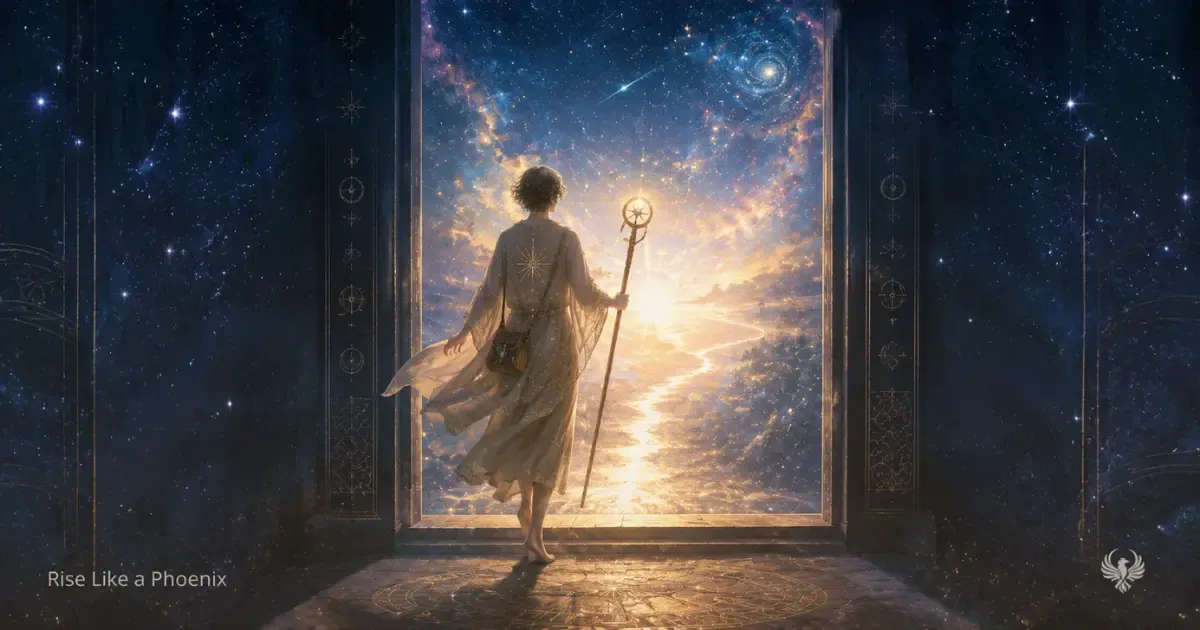
A Reflective Guide to Trust, Thresholds, and the First Step of the Soul's Journey
The Fool is often misunderstood.
At first glance, the name may suggest foolishness, immaturity, recklessness, or lack of awareness. In ordinary language, to be called a fool is rarely a compliment.
But in tarot, The Fool carries a deeper meaning.
The Fool stands at the beginning of the Major Arcana, before the journey has fully unfolded. He represents the threshold before experience has hardened into identity, before the path has become clear, before the soul knows what it will meet.
He begins before certainty.
That is what makes the card both beautiful and risky.
The Fool does not know the whole path.
He cannot see every consequence.
He has not yet learned every lesson.
But he carries something essential: openness, trust, movement, and willingness to enter life.
In the larger map of the Major Arcana, The Fool begins the soul's movement through growth, shadow, surrender, awakening, and integration. Without the Fool, the journey does not begin.
The Fool is not empty because he lacks wisdom.
He is open because the journey has not yet hardened him.
The Fool as the Beginning of the Major Arcana
The Fool is commonly associated with a number zero.
Zero is not emptiness in a meaningless sense.
It is potential before form.
It is the open field before identity becomes fixed.
It is the space before a path has been chosen and a life has taken shape.
This is why The Fool belongs at the beginning of the Major Arcana.
He represents the soul before experience defines it.
He is the first breath before the story unfolds.
He is the step before the map makes sense.
As explored in the article The Major Arcana as a Map of Spiritual Awakening: A Symbolic Guide to Inner Growth, Shadow, Surrender, and Wholeness, these cards can be read as symbolic stages of inner growth.
The Fool is the first threshold in that map — not because he is spiritually lower than the cards that follow, but because every journey needs a beginning.
The Fool can appear when we are beginning a spiritual practice, leaving an old role, starting again after loss, entering a new relationship, moving toward a creative calling, or stepping into a version of life that cannot yet be fully explained.
He reminds us that every real beginning contains uncertainty.
Symbolism of the Fool
Different tarot decks portray The Fool in different ways.
In many decks, The Fool is shown near the edge of a path, cliff, or open landscape. This image suggests threshold, possibility, risk, and movement into the unknown. Other symbols may emphasize innocence, instinct, freedom, spiritual protection, or traveling lightly.
In the Thoth deck, The Fool is especially dynamic. The card carries the feeling of creative life-force before it settles into fixed form. It is filled with movement, instinct, innocence, fertility, and sacred chaos. The Fool is not merely a person about to take a step. He is the eruption of life before it becomes ordered, named, controlled, or fully understood.
This is why The Fool should not be reduced to a single image or simple meaning.
Whether the card appears as a traveler, divine child, holy innocent, wanderer, initiate, or creative force, the deeper theme remains similar.
The Fool represents the beginning before the certainty.
He carries the potential, but not yet mastery.
He carries trust, but not yet full understanding.
He carries openness, but not yet integration.
The symbols around The Fool often ask:
- What is beginning?
- What remains unformed?
- What kind of trust is present?
- What kind of awareness is missing?
- What is moving before the mind can fully explain it?
This is where The Fool becomes more than a card of optimism. He asks us to look closely at the quality of the step being taken.
Trust Before Certainty Is Not Naivety
At the heart of The Fool is the question of trust.
Not blind trust.
Not denial.
Not the fantasy that everything will unfold exactly as we want.
The Fool teaches a different kind of trust: the willingness to take the next step without demanding complete certainty before life is allowed to move.
This is difficult because the mind often wants guarantees.
It wants to know the outcome before beginning.
It wants proof that no pain, failure, embarrassment, or disappointment will occur.
But some thresholds do not work that way.
Some choices only become clearer after we begin walking.
Some paths only reveal themselves through participation.
Some forms of growth require movement before complete readiness arrives.
The Fool does not ask us to abandon discernment.
He asks us to notice where fear has mistaken control for wisdom.
This connects closely with inner authority in Tarot as explained in Tarot and Inner Authority: Reclaiming Guidance Without Surrendering Responsibility. The card does not remove responsibility from the reader. It brings the reader back to the quality of their own participation.
There is a difference between trust and naivety.
Naivety says, "Nothing difficult will happen."
The Fool says, "I cannot know everything before I begin."
Naivety ignores signs.
The Fool stays open to signs.
Naivety avoids responsibility.
The Fool learns through movement.
Naivety denies risk.
The Fool meets risk as part of the path.
This distinction matters. The Fool is not permission to leap into every situation, ignore reality, dismiss red flags, or call recklessness spiritual courage.
Healthy Fool energy is open, responsive, and alive.
Unhealthy Fool energy is impulsive, disconnected, and unwilling to learn.
When The Fool appears, the question is not simply, "Should I take the leap?"
The deeper question is:
"What kind of beginning is this, and what part of me is taking the step?"
The Shadow of The Fool
Every Major Arcana card has a shadow expression.
The Fool's shadow appears when openness becomes carelessness.
It appears when someone refuses to see consequences, repeats avoidable mistakes, or calls impulsiveness "trust".
It appears when risk is romanticized because ordinary responsibility feels too limiting.
The shadow Fool may say:
"I do not need to think about this."
"If it feels exciting, it must be right."
"The universe will handle it, so I do not need to be honest."
This is not spiritual trust. It is evasion dressed in spiritual language.
The Fool's innocence is sacred only when it remains connected to life. When innocence refuses relationship with reality, it becomes dangerous.
The does not mean The Fool must become fearful or heavy. The card does not ask us to replace openness with suspicion. It asks us to mature our trust.
Mature trust can remain open while still paying attention.
It can begin without knowing everything, while still listening to the body, the timing, the situation, and the truth of what is present.
The Fool and the Soul Before Identity
On a deeper level, The Fool represents the soul before identity becomes fixed.
This does not mean the person is immature. It means the card may be pointing to a state of openness before the self becomes too tightly shaped by roles, wounds, achievements, failures, or expectations.
In life, we often become attached to who we think we are.
We become the responsible one, the wounded one, the successful one, the spiritual one, the caretaker, the achiever, the skeptic, or the survivor.
Some identities protect us for a time. But eventually, even protective identities can become too small.
The Fool can appear when life asks us to loosen our grip on an old self-image.
He may show up when we are no longer able to live from an old role, but do not yet know who we are becoming.
This can feel vulnerable. It can also be freeing.
The Fool reminds us that there is a part of the soul that exists before the names, before the explanations, before the roles, before the fear of looking foolish.
That part may not be fully formed, but it is alive.
That is why The Fool is not only a beginning card. He is also a return card.
After disappointment, The Fool asks whether we can begin again without becoming cynical.
After grief, he asks whether life can still be entered gently.
After failure, he asks whether the self can move without being entirely defined by what happened.
After too much control, he asks whether trust can return.
The Fool is the sacred beginner within us — not because he knows nothing, but because he has not allowed experience to close the door to life.
When The Fool Appears in a Reading
When The Fool appears in a reading, it often points to a threshold.
Something is beginning, or something in you is being asked to begin again.
This may be outer or inner.
You may be starting a new chapter in work, relationship, creativity, healing, spiritual practice, or self-understanding. Or you may be standing at an inner threshold where the old way of seeing yourself no longer fits, but the new way has not yet formed.
The Fool can suggest freshness, openness, risk, trust, beginner's mind, freedom, and the need to loosen control.
But the meaning depends on the question and the surrounding cards.
In a relationship reading, The Fool may ask whether the connection is being entered with honest openness or with avoidance of obvious truth.
In a career reading, The Fool may suggest a new direction, creative risk, or the beginning of a path that cannot yet be fully mapped. But it may also ask whether the step is grounded enough to sustain.
In a grief or transition reading, The Fool may point to the fragile courage of beginning again after an ending. This does not erase grief or demand immediate optimism. It simply suggests that some part of life may be quietly asking for a first step.
In a spiritual reading, The Fool may show the beginning of a path that the mind cannot yet organize. This can be beautiful, but it also requires steadiness.
Because tarot can stir the body as well as the mind, it helps to notice whether The Fool brings calm openness, anxious urgency, contraction, excitement, relief, or pressure.
The card may be inviting movement.
But the body may reveal whether that movement is grounded or reactive.
Questions to Ask When The Fool Appears
When The Fool appears, do not rush to turn it into a yes or no answer.
Sit with the threshold.
You might ask:
- What is beginning in my life right now?
- What threshold am I standing at?
- Where am I being asked to begin before I feel fully certain?
- What am I carrying with me?
- What am I being invited to leave behind?
- Am I trusting life, or avoiding responsibility?
- Where has fear made me confuse control with safety?
- Where has impulse disguised itself as freedom?
- What would one grounded first step look like?
- What support do I need before stepping forward?
These questions help keep The Fool connected to awareness.
They allow the card to remain open without becoming vague, and spiritually meaningful without becoming irresponsible.
A Simple Practice with The Fool
To work with The Fool intentionally, remove the card from your deck and place it in front of you.
Take a few moments to look at the image.
Do not rush to interpret it.
Notice what draws your attention first.
Is there movement?
Lightness?
Chaos?
Innocence?
Risk?
Freedom?
Instinct?
Fear?
Excitement?
Then journal with three questions:
- What part of me is ready to begin?
Let this answer be honest. It may be a hopeful part, a tired part, a curious part, or a part that knows something old has completed.
- What part of me is afraid of not knowing?
This question helps you notice the fear beneath control. The goal is not to shame the fear, but to understand what it is trying to protect.
- What is one small, grounded step I can take without demanding full certainty?
The Fool does not require you to leap across your whole life at once. Sometimes the sacred beginning is small.
A conversation.
A page written.
A walk taken.
A decision named.
A boundary acknowledged.
A possibility allowed.
After journaling, pause and notice your body.
Do you feel open, calm, tense, restless, excited, contracted, or pressured?
The body may help you understand whether the card is inviting trust, revealing fear, or showing urgency that needs grounding.
This practice is not about forcing an answer.
It is about meeting the beginning honestly.
The First Step Is Not the Whole Path
The Fool begins the Major Arcana not because he has mastered the journey, but because he is willing to enter it.
He reminds us that beginnings are sacred.
But they are not exempt from responsibility.
The Fool does not ask us to know the whole path.
He does not ask us to become reckless in the name of trust.
He does not ask us to ignore what is visible.
He asks us to meet the threshold honestly.
There are moments when the old identity is too small, but the new one has not formed.
There are moments when waiting for complete certainty becomes another way of not living.
There are moments when the soul knows it must begin, even while the mind still wants a guarantee.
The Fool stands in that moment.
Open.
Unfinished.
Unproven.
Alive.
The next card in the Major Arcana, The Magician, begins to show how openness becomes focus, will, and conscious action. But The Fool comes first because no path can be lived from the outside.
The first step does not need to contain the whole path.
It only needs to be taken with enough openness, honesty, and care to begin.