
The Zodiac Archetypes
The zodiac is more than a collection of personality types. Explore the 12 signs as archetypal fields of experience, spiritual learning, and conscious growth within a larger symbolic system.

Understanding the 12 Signs as Spiritual Lessons, Not Personality Types
For many people, astrology begins with a simple question:
What is your sign?
The answer usually refers to the Sun sign. From there come descriptions of Aries as bold, Taurus as stubborn, Gemini as curious, Scorpio as intense, Pisces as sensitive, and countless other personality associations.
These descriptions can offer a first glimpse into astrology, but the zodiac contains far more depth than personality traits.
Each zodiac sign represents an archetypal mode of experience. It describes a particular way that life, consciousness, and human development can express themselves.
Aries brings us into relationship with will and emergence.
Taurus brings us into form, stability, and value.
Gemini introduces differentiation, thought, and exchange.
Each sign carries its own questions, tensions, capacities, and possibilities for growth.
This is where zodiac signs become useful for spiritual reflection.
A sign does not define a person. It gives us symbolic language for exploring an aspect of human experience.
And every one of us participates in the whole zodiac.
Explore more in Astrology 101: Understanding the Building Blocks of a Birth Chart.
What Is a Zodiac Archetype?
An archetype is a recurring pattern that appears across human life in many forms.
We encounter archetypes through stories, symbols, relationships, choices, inner conflicts, cultural patterns, and spiritual traditions.
Astrology organizes twelve broad archetypal fields through the zodiac. A zodiac sign can therefore be understood as a quality or mode through which consciousness expresses itself.
Aries, for example, carries themes of emergence, initiative, will, assertion, and the capacity to begin.
Libra carries themes of relationship, reciprocity, balance, encounter, and the ongoing negotiation between self and other.
Scorpio carries themes of depth, power, vulnerability, loss, truth, and transformation.
None of these descriptions tells us what an Aries person, Libra person, or Scorpio person will do. Human beings contain many influences, histories, relationships, choices, and forms of conditioning. Even astrologically, a birth chart contains planets, houses, aspects, angles, and all twelve signs.
The archetype gives us a field to explore.
The person remains larger than the archetype.
This distinction matters because astrology becomes limiting when symbolic patterns turn into labels. Saying that someone "is a Scorpio" can easily become shorthand for a fixed set of characteristics.
A more useful question is:
What does the Scorpio archetype reveal about the human experience of depth, power, vulnerability, and transformation?
That question remains open enough for awareness.
Explore more in The Birth Chart in Astrology: A Snapshot of Consciousness (Not Identity).
What Do We Mean by Spiritual Lessons?
Calling the zodiac signs spiritual lessons requires care.
A spiritual lesson is not an assignment given to a particular sign. It does not tell us why a soul incarnated, what someone must accomplish, or whether they have succeeded spiritually.
Here, a spiritual lesson means a field of experience through which awareness can deepen.
Every archetype contains capacities to develop, tensions to navigate, and questions that cannot always be answered once and permanently.
Aries may bring us into questions such as:
- How do I act with courage without becoming driven by impulse?
- How do I develop will without forcing my will onto others?
- When is initiative needed?
- When does action need awareness before movement?
Taurus may bring different questions:
- What creates genuine stability?
- What do I value enough to sustain?
- When does persistence become attachment?
- How do I live fully in material reality without becoming defined by what I possess or preserve?
Libra may ask us to explore relationship:
- How much of myself can I bring into connection?
- When does cooperation become self-abandonment?
- How do I make room for another person without losing my own center?
- What does meaningful reciprocity require?
These questions are human questions.
Someone does not need an Aries Sun to encounter will, a Taurus Sun to encounter attachment, or a Libra Sun to struggle with balance in relationship.
The Zodiac as a Spiral of Learning
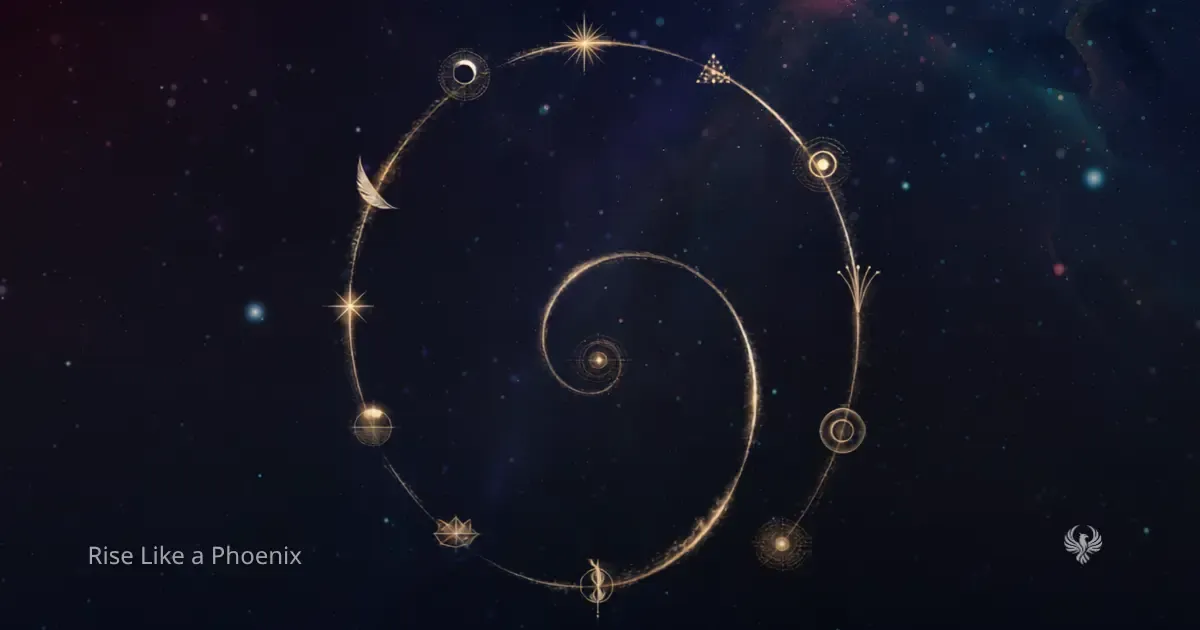
The zodiac is often represented as a circle. For spiritual reflection, a spiral offers an even richer image.
A circle returns to the same point.
A spiral also returns, but it does so after movement and experience.
We may encounter the same fundamental theme many times throughout life without meeting it in exactly the same way.
A person may struggle with boundaries in one relationship and revisit the same theme years later in a different context.
Responsibility may appear through work at one stage of life and through caregiving at another.
Questions of identity may return after success, loss, aging, parenthood, spiritual change, or major life transitions.
The theme is familiar. The person meeting it has changed.
This is one way to understand the zodiacal journey.
We keep what experience has taught us, even when integration remains incomplete.
Old patterns may return.
New circumstances can expose another layer.
Greater awareness may allow a different response.
The spiral also protects us from turning the zodiac into a spiritual ladder.
Pisces is not spiritually superior to Aries because it appears later in the zodiacal sequence.
Aries does not represent an inferior level of consciousness.
Each archetype contains an essential dimension of experience.
Emergence matters.
Embodiment matters.
Relationship matters.
Discernment matters.
Transformation matters.
Surrender matters.
And once a cycle reaches Pisces, life does not remain dissolved forever.
Aries emerges again.
The journey continues.
Each person also travels through these themes differently. There is no single sequence by which we can determine another person's spiritual development, and a birth chart does not provide a literal map of someone's reincarnational status.
The zodiac is more useful as a symbolic map of recurring experience: one we may revisit with increasing awareness as life unfolds.
The Twelve Zodiac Archetypes at a Glance
Each sign deserves its own deeper exploration. For now, these brief descriptions show how the twelve archetypes contribute different dimensions to the whole.
Aries: Emergence and Will
Aries carries the impulse to begin.
Its field includes initiative, courage, assertion, independence, movement, and the emergence of individual will.
Aries raises questions about our relationship with action: when to move, how to claim space, and how to use will consciously.
Its challenges can appear when urgency overtakes awareness or when assertion becomes force.
At its more integrated expression, Aries supports the capacity to act clearly while remaining aware of consequence, relationship, and purpose.
Taurus: Embodiment and Stability
Taurus brings attention toward form, matter, continuity, value, and preservation.
It explores what allows something to take root and endure.
Through Taurus, we encounter our relationship with the body, material reality, security, resources, pleasure, and what we consider worth sustaining.
Its tensions often involve the difference between stability and stagnation, or between valuing something and becoming attached to preserving it.
Taurus reminds us that spiritual life also has to be lived through form.
Gemini: Differentiation and the Movement of Mind
Gemini explores curiosity, perception, language, exchange, and the discovery of difference.
It gathers information, connects ideas, asks questions, and learns through movement between perspectives.
Its tensions can appear through fragmentation, distraction, or an endless accumulation of information without deeper understanding.
The Gemini archetype asks how the mind can remain curious while developing enough discernment to recognize meaningful connections.
Cancer: Belonging and the Inner Home
Cancer brings us into the territory of emotional roots, belonging, care, protection, memory, and inner security.
It asks what allows us to feel held and what we instinctively protect.
Cancer can reveal the importance of connection while also showing how familiar emotional patterns can become protective shells.
Its deeper questions concern our relationship with vulnerability, attachment, belonging, and the creation of an inner home that can support growth.
Leo: Creative Identity and the Heart
Leo concerns visibility, creative expression, identity, vitality, and the courage to bring something of ourselves into the world.
It explores the human need to be seen and the equally important capacity to see and affirm others.
Its tensions can arise when expression depends too heavily on recognition or when identity becomes something that constantly requires reinforcement.
Integrated Leo allows individual radiance to become generous rather than self-enclosed.
Virgo: Discernment and Refinement
Virgo explores discernment, attention, refinement, service, skill, and our relationship with imperfection.
It notices what needs adjustment and asks how something can function more effectively.
Its challenges may emerge through excessive self-criticism, control, or the belief that everything must be perfected before it has value.
Virgo's deeper potential lies in careful attention that serves life without becoming consumed by perfection.
Libra: Relationship and Reciprocity
Libra brings the self into conscious encounter with another.
Its themes include relationship, balance, fairness, cooperation, perspective, and reciprocity.
Through Libra, we learn that another person's reality cannot simply be absorbed into our own. Relationship requires negotiation, listening, boundaries, and adjustment.
Its tensions may appear through indecision, avoidance of conflict, or sacrificing authenticity for harmony.
The archetype asks how self and other can coexist without either disappearing.
Scorpio: Depth and Transformation
Scorpio enters the territory that cannot always be managed through surface understanding.
Power, vulnerability, intimacy, fear, desire, secrecy, loss, trust, control, truth, and transformation all belong to its symbolic field.
Scorpio can express reactively through defensiveness, suspicion, fixation, or attempts to control what feels threatening.
With greater awareness, the same capacity for intensity can support honesty, psychological depth, discernment, and the willingness to remain present when something must change.
Transformation here does not mean permanent spiritual advancement. It means becoming willing to encounter what experience has revealed.
Sagittarius: Meaning and the Expanding Horizon
Sagittarius explores meaning, belief, perspective, exploration, aspiration, and the desire to understand a larger world.
It moves beyond accumulated facts toward interpretation.
Its challenges can appear when conviction hardens into certainty or when the search for expansion makes ordinary limits difficult to accept.
Sagittarius asks how vision can remain alive without closing the mind to what experience may still teach.
Capricorn: Structure and Responsibility
Capricorn brings attention to structure, responsibility, authority, consequence, discipline, and the long process of building something that can endure.
It asks what maturity requires when intention meets reality.
Its tensions may arise through rigidity, excessive control, status-seeking, or identification with achievement.
Integrated Capricorn develops the capacity to hold responsibility without allowing duty or external authority to become the entire measure of a life.
Aquarius: Individuality and Collective Life
Aquarius explores the relationship between the individual and the larger human field.
Its themes include independence, innovation, community, freedom, systems, collective participation, and ideas that challenge established patterns.
Its tensions can emerge through detachment, rebellion for its own sake, or attachment to ideals that lose contact with individual human experience.
Aquarius asks how freedom and individuality can contribute to something larger without demanding conformity from either the self or the group.
Pisces: Dissolution and Union
Pisces brings us toward permeability, compassion, imagination, surrender, interconnectedness, and the loosening of rigid boundaries.
It explores experiences that cannot always be contained through control or intellectual definition.
Its challenges can appear through overwhelm, avoidance, idealization, blurred boundaries, or difficulty in remaining grounded in material reality.
Integrated Pisces allows openness and compassion to coexist with discernment and form.
Then the zodiac returns to Aries, and something begins again.
The Structure Behind the Twelve Signs
The twelve zodiac signs are not twelve unrelated symbols. They arise form an underlying structure.
Two of the most important organizing principles are element and modality.
The Four Elements
The zodiac contains four elements:
- Fire – Aries, Leo, Sagittarius
- Earth – Taurus, Virgo, Capricorn
- Air – Gemini, Libra, Aquarius
- Water – Cancer, Scorpio, Pisces
Each element represents a broad mode of experience.
Fire relates to vitality, inspiration, movement, and expression.
Earth relates to embodiment, form, material reality, and stabilization.
Air relates to thought, exchange, perspective, and relationship through ideas.
Water relates to feeling, sensitivity, depth, and experiences that often reach beyond purely intellectual understanding.
The three signs within an element share something fundamental, yet they express that element very differently.
That difference becomes clearer when we add modality.
Cardinal, Fixed, and Mutable
The zodiac also contains three modalities.
- Cardinal – initiation and movement into experience
- Fixed – concentration, stabilization, and continuity
- Mutable – adaptation, transition, and movement between states
Each element appears only once in each modality.
| Element | Cardinal | Fixed | Mutable |
|---|---|---|---|
| Fire | Aries | Leo | Sagittarius |
| Earth | Capricorn | Taurus | Virgo |
| Air | Libra | Aquarius | Gemini |
| Water | Cancer | Scorpio | Pisces |
This helps explain why Aries, Leo, and Sagittarius can all belong to Fire without representing the same archetype.
Aries is Cardinal Fire: fire initiating.
Leo is Fixed Fire: fire concentrating and sustaining.
Sagittarius is Mutable Fire: fire seeking expansion, movement, and broader meaning.
The same principle applies throughout the zodiac.
Understanding this architecture moves us away from memorizing twelve personality descriptions and toward seeing how the system itself is organized.
Zodiac Signs Exist in Relationship
Every sign also has an opposite sign:
- Aries ↔ Libra
- Taurus ↔ Scorpio
- Gemini ↔ Sagittarius
- Cancer ↔ Capricorn
- Leo ↔ Aquarius
- Virgo ↔ Pisces
Opposition in astrology does not automatically mean conflict.
These pairs reveal complementary tensions.
Aries develops individual will while Libra brings awareness of relationship.
Taurus stabilizes and preserves while Scorpio confronts change and transformation.
Gemini explores information and multiple perspectives while Sagittarius searches for coherence and meaning.
Cancer attends to emotional roots and belonging while Capricorn develops structure and responsibility in the wider world.
Leo explores individual creative expression while Aquarius considers participation in the collective.
Virgo differentiates, refines, and discerns while Pisces opens toward surrender, permeability, and wholeness.
Neither side of an axis is complete by simply rejecting the other.
Part of integration may involve discovering how both principles can remain present.
Reactive, Conscious, and Integrated Expression
An archetype can appear through many behaviors.
For this reason, it is more useful to observe how a pattern is being expressed than to divide people into evolved and unevolved versions of a sign.
Three broad lenses can help.
Reactive Expression
The archetype operates largely through conditioning, defense, fear, compulsion, or automatic reaction.
Aries initiative may become impulsive action.
Cancer protection may become withdrawal.
Leo expression may become dependent on validation.
Scorpio self-protection may become secrecy or control.
Conscious Expression
The person becomes increasingly aware of the pattern.
There is more space between impulse and response. The underlying need, fear, desire, or capacity becomes easier to recognize.
Awareness does not guarantee perfect behavior. It creates greater possibility for choice.
Integrated Expression
The archetypal capacity becomes more flexible and can coexist with other parts of experience.
Aries can act while considering Libra's awareness of relationship.
Virgo can discern without losing Pisces' capacity for acceptance.
Taurus can create stability while remaining capable of Scorpio's necessary transformation.
Integration is not a permanent spiritual rank.
A person may respond consciously in one part of life and reactively in another.
A familiar pattern can reappear under pressure.
The spiral continues.
What changes is our capacity to recognize what is happening and respond with greater awareness.
Every Birth Chart Contains the Whole Zodiac
Your Sun sign is one part of your birth chart.
The complete zodiac is present in every chart, divided through the twelve houses.
Some signs may contain several planets.
Others may contain none.
An empty sign does not disappear from the chart.
This is one reason all twelve archetypes are relevant.
Someone with no planets in Scorpio will still encounter the Scorpio field somewhere within the birth chart. More importantly, themes such as trust, power, intimacy, loss, control, and transformation are part of human experience regardless of astrological placement.
The zodiac therefore offers a shared symbolic vocabulary.
It can help us explore differences without reducing people to categories.
How Signs Work with Planets and Houses
A zodiac sign becomes more meaningful in chart interpretation when we understand what it is modifying.
A simple framework helps:
Planet = function
Sign = mode of expression
House = field of experience
A planet symbolizes a particular function of consciousness.
A sign describes the quality or manner through which that function expresses itself.
A house describes the area or field of experience where that symbolism becomes relevant.
These layers should remain distinct.
For example, a sign and a house are not interchangeable simply because some modern interpretations associate Aries with the First House, Taurus with the Second, and so on.
Houses and signs perform different symbolic roles within a chart. Understanding those distinctions becomes increasingly important as chart interpretation grows more complex.
Explore more in Houses as Fields of Experience in Astrology: Not Life Outcomes.
An Esoteric View of the Zodiac
Esoteric astrology adds another question to zodiac interpretation:
What can this archetype reveal about the development of consciousness?
That question shifts attention toward awareness, integration, responsibility, and our relationship with recurring patterns.
A modality cannot tell us someone's spiritual level.
A zodiac placement cannot tell us whether someone is spiritually advanced.
The value of these systems lies in the questions they open.
What are we becoming aware of?
Where are we repeating an automatic pattern?
What capacity is asking for greater integration?
Where has an old understanding become too narrow?
What changes when we meet the same archetypal theme with more experience and consciousness than before?
These questions leave room for spiritual exploration while preserving inner authority.
Explore more in The Ultimate Guide to Esoteric Astrology: A Spiritual Map of the Soul (Not Prediction).
When Zodiac Archetypes Become Labels
Zodiac symbolism becomes less useful when interpretation hardens into certainty.
This can happen when we:
- reduce someone to their Sun sign
- assume a sign determines personality or behavior
- describe people as spiritually evolved or unevolved
- use difficult placements as explanations for harmful behavior
- assume opposite signs are inherently incompatible
- treat archetypal tendencies as destiny
- assign spiritual status based on a birth chart
- force lived experience to fit an astrological description
A birth chart can provide language for reflection. It cannot replace direct observation of ourselves or another person.
If a description does not match lived experience, the answer is not to force the person into the description. It may mean the symbolism is operating differently, the chart context changes its expression, the interpretation is incomplete, or the framework simply does not illuminate that experience.
Discernment remains essential.
Explore more in Astrology Myths that Prevent Real Understanding: How to See More Clearly.
You may also be interested in Astrology and Inner Authority: How to Use Astrology Without Giving Away Your Power.
Exploring the Zodiac More Deeply
Understanding the zodiac is less about memorizing twelve definitions and more about seeing the relationships within the whole system.
The elements reveal broad modes of experience.
The modalities show how energy begins, stabilizes, and changes.
The polarities and opposite axes reveal complementary tensions.
The symbols of the signs add another layer of archetypal meaning.
Individual signs show how these structures combine into twelve distinct fields of experience.
Esoteric frameworks add further perspectives on consciousness and spiritual development when approached with care.
And each sign can be explored through its reactive, conscious, and increasingly integrated expressions without turning those expressions into judgements about the person.
This brings us back to the spiral.
We will meet it more than once.
We meet attachment more than once.
We meet relationship, responsibility, power, uncertainty, discernment, loss, surrender, and renewal many times.
We may respond differently each time.
The zodiac offers a language for noticing these recurring fields of human experience. Its spiritual value lies less in telling us who we are than in helping us see more clearly how we are meeting what life places before us now.
The archetypes remain.
Our relationship with them can change.